
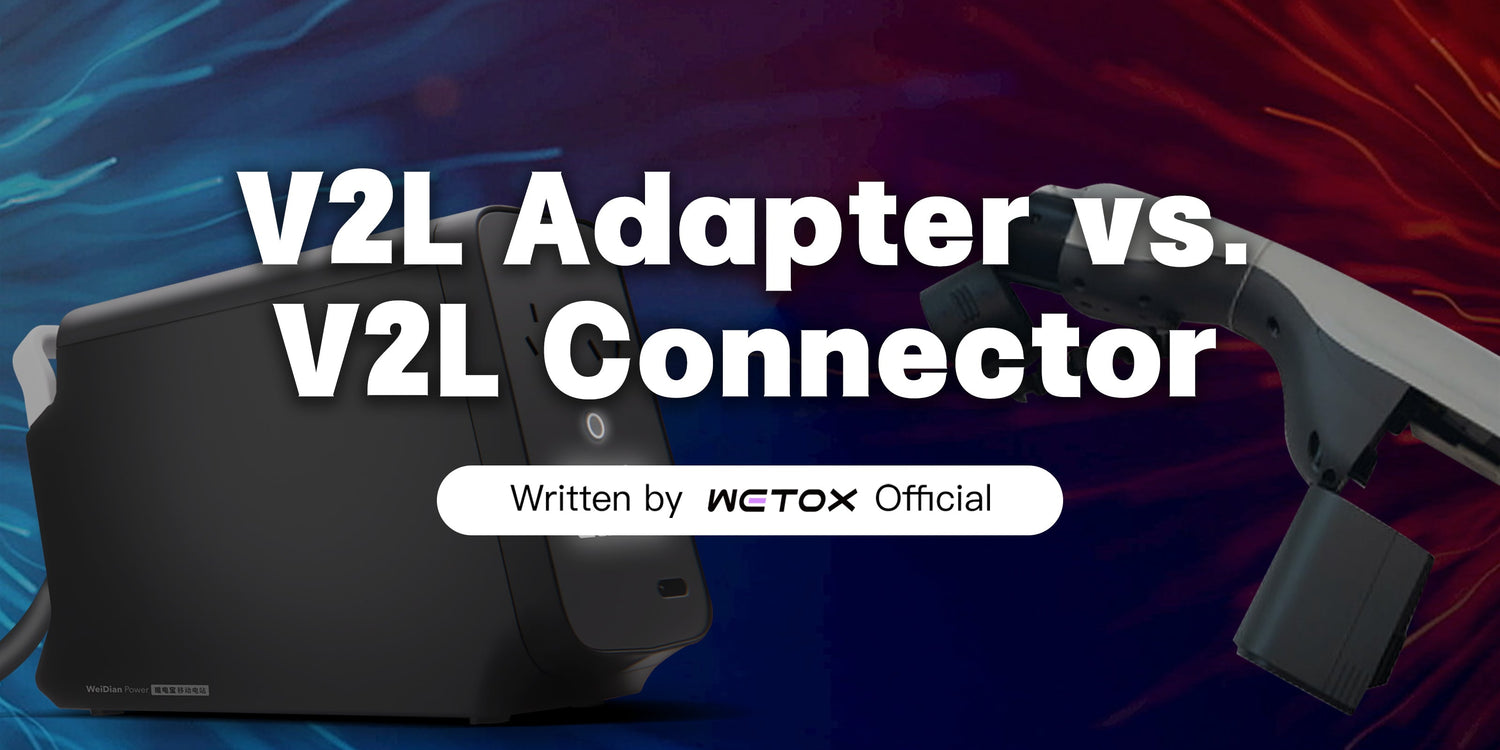
Recently, multiple online shopping platforms have started selling a device marketed as a "NACS V2L connector." It features a plug that fits Tesla’s charging port and is priced surprisingly low. However, many Tesla owners who purchased it quickly discovered a frustrating reality: it doesn’t work.
What’s the catch? The truth is, this device wasn’t actually designed for Tesla vehicles. Instead, it is intended for Kia, Hyundai, and other brands that have recently adopted the NACS charging standard for their native bidirectional systems.

In a previous article, WETOX explained that Vehicle-to-Load (V2L) works by converting a vehicle's DC battery power into usable AC power.
Take the Kia EV6 as an example: its factory-integrated bidirectional On-Board Charger (OBC) module enables V2L via a J1772 AC discharge connector. As future Kia and Hyundai models transition to the NACS port, they will simply require a NACS-style AC discharge connector to perform the same function.
Despite differences in physical design, these "connectors" serve a very simple purpose—they act as a passive bridge to adapt the vehicle’s port into a standard household power outlet. Because the heavy lifting (the power inversion) happens inside the car, these connectors don’t require communication protocols or internal inverter circuitry. This makes them compact, inexpensive, and easy to manufacture.
Unfortunately, because most Tesla models lack a bidirectional OBC, they cannot utilize these simple, passive connectors.

The WETOX D2 is specifically engineered for V2L in the Tesla Model 3, Model Y, Model S, and Model X. Unlike the passive connectors mentioned above, the D2 draws raw DC power directly from the vehicle’s port and converts it into AC power through an advanced, high-efficiency inverter built into the device itself.
While a Tesla-compatible DC discharge adapter and a Kia-compatible AC discharge connector may appear to serve the same "V2X" purpose, they are fundamentally different technologies. A DC discharge device for Tesla requires intricate, high-precision electronic components and a full-scale inverter within the unit. This results in significantly higher production costs and a larger physical footprint compared to a Kia’s simpler AC connector.
Despite these engineering challenges, WETOX remains committed to providing Tesla owners with the most advanced, high-quality, and cost-effective DC discharge solutions on the market.

The NACS standard integrates both AC and DC charging into a single physical design, which can be confusing. To clarify, let’s compare it to Europe’s CCS2 standard or China’s GB/T standard:
In Europe, the fast-charging interface is CCS2, while the slow-charging interface is Type-2 (similarly, in North America, the CCS1 standard uses a separate J1772 connector for slow charging). In China, the GB/T standard physically separates the DC fast-charging port from the AC slow-charging port.
Only vehicles with built-in bidirectional OBCs can use Type-2, J1772, or GB/T AC connectors for V2L. Vehicles like Tesla, which lack that internal hardware, must utilize the DC fast-charging pins (via CCS2, GB/T, or NACS) to draw power.
The NACS connector does not distinguish between DC and AC pins externally, but the internal engineering logic remains the same. Essentially, the vehicle still maintains separate DC and AC power paths, even though they are unified into a single, user-friendly port.

After reading this article, we hope you now have a clear understanding of the difference between a specialized DC discharge adapter and a simple AC discharge connector. If you are a Tesla owner looking to unlock the power of your vehicle, the WETOX PowerShare D2 is the only right choice for your needs.


1 comment
Ken
Is it possible add DC output mode too? We could use it to connect it back to power wall at home with MC4 connector act as solar panel output, bypass Tesla’s restrictions.
Leave a comment
This site is protected by hCaptcha and the hCaptcha Privacy Policy and Terms of Service apply.