

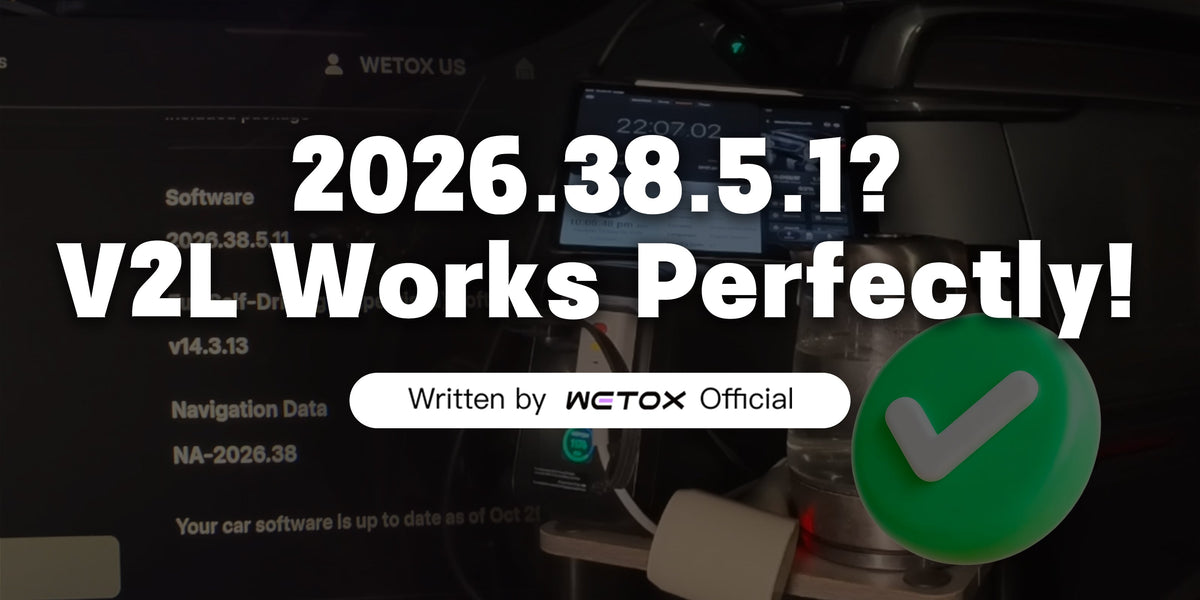
Recently, following the release of Tesla's 2026.38.5.1 software update, a troubling rumor began making waves across forums. Owners started reporting that their third-party DC V2L adapters were suddenly shutting off after 3 to 20 minutes of use, accompanied by the fault code
BMS_a076_SW_Dch_While_Charging. This quickly sparked a panic: Is Tesla intentionally blocking all third-party V2L devices?
So, is the rumor actually true? Let’s cut to the chase: Yes, the issue users are reporting is real, and quite a few owners using V2L devices have experienced these random shutoffs. But here is the catch—this is strictly a hardware and software issue isolated to certain third-party V2L adapter brands. It is not an industry-wide block by Tesla. The WETOX D2 is working flawlessly.
That initial forum post quickly caught fire across major Tesla-focused media outlets, causing a bit of a panic in the community. The moment we saw the news, the WETOX team jumped into action for real-world testing.
In our uncut validation video (shot on the day the news broke using Tesla firmware 2026.38.5.11), we fluctuated the power load between 1,000W and 2,500W for a solid 20 minutes. The result? Zero interruptions and zero power drops. Keep in mind, this video only shows a snippet of our testing process; our internal, multi-hour endurance tests ran just as smoothly. (Note: While that video was shot on 2026.38.5.11, at the time of writing this post, we’ve already tested on the newer 2026.38.5.12 update—and everything is still working perfectly.)
In fact, since early October, as we gear up for our first batch of Kickstarter deliveries, every single WETOX D2 unit undergoes rigorous factory aging and actual on-car testing before shipping. We’ve been running these daily validations on our own test vehicles across various firmware versions—including earlier builds like 2026.38.5.1 and 2026.38.5.10—and we have never encountered this cutout issue.
The Tech Behind the Glitch
Back to the main point: If you’ve already secured a WETOX D2, breathe easy. If you’re on the fence about getting one, don't let this rumor kill your vibe.
Tesla’s recent OTA update was likely aimed at optimizing their core charging architecture, and the V2L software loop simply got caught in the crossfire. That specific fault code you might be seeing online—
BMS_a076_SW_Dch_While_Charging—isn’t actually new. It’s been lurking around since the very first day third-party V2L devices hit the market. The real difference is in how an adapter's internal hardware is built to handle it.
So, why are other brands failing while WETOX stays online? The answer comes down to tech architecture.
Most V2L adapter manufacturers out there take a shortcut: they write a basic program based on the CAN bus, and then slap in an off-the-shelf, third-party SECC module to translate that data into PLC (Power Line Communication). This approach has two fatal flaws:
-
The Middleman Problem: Translating data through an extra module introduces a ton of variables, making troubleshooting a nightmare.
-
The Black Box Effect: That third-party SECC code is a "black box" controlled entirely by the module supplier. When things break after a Tesla OTA, the supplier has no real incentive to fix it, and the adapter brand doesn’t have the underlying technical capability to do it themselves.
The WETOX Difference: Native PLC & In-House Code

WETOX refused to take that shortcut from day one. Instead of relying on a middleman SECC module, we built a native PLC architecture utilizing HomePlug GreenPHY chips directly.
Our engineering team wrote and owns the entire underlying protocol stack for both ISO 15118 and DIN 70121. Because we understand the fundamental logic from the ground up, if a future Tesla OTA update ever does throw a curveball, we aren't waiting on a supplier. We can instantly pinpoint the issue, adjust our software, and push an OTA firmware update directly to your WETOX D2—keeping you powered up without missing a beat.
We know a 20-something-minute video clip might not be enough for the ultimate skeptics. Moving forward, as Tesla continues to roll out newer software versions, we will be dropping extended, long-form test videos to give you complete peace of mind.
Stay tuned, and stay powered!

Leave a comment
This site is protected by hCaptcha and the hCaptcha Privacy Policy and Terms of Service apply.